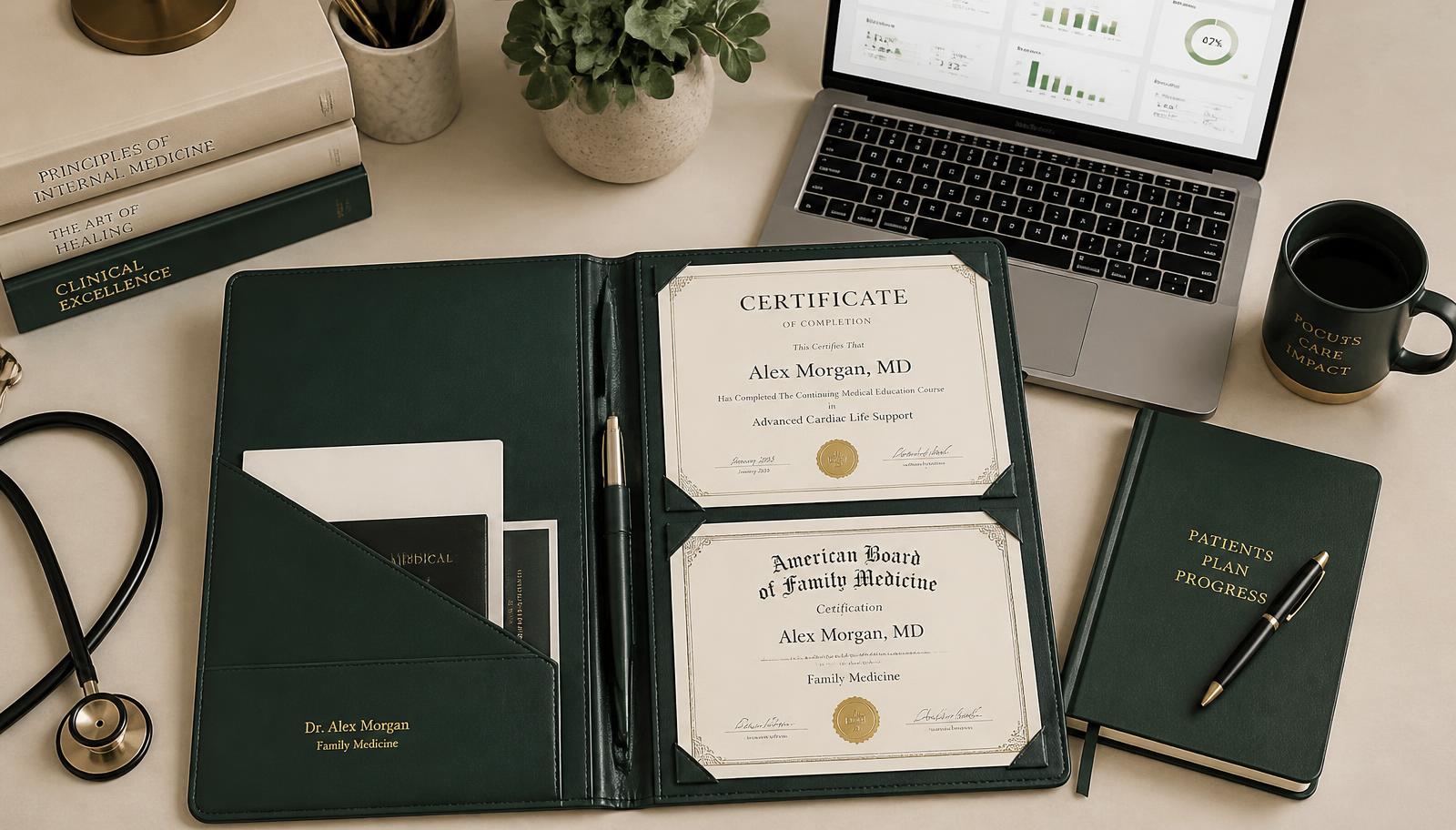
Shortlisting panels spend minutes, not hours, on your evidence. A portfolio that makes them hunt for proof scores as if the proof were absent.
Start from the specification, not the folder
Every specialty application and every job advert has a person specification with essential and desirable criteria. Print it. Against each line, write the single strongest piece of evidence you hold. Where the line is blank, you have found your work plan for the next six months.
This is the whole method. Everything below is detail.
The six domains panels look for
1. Clinical knowledge and skills
Logbooks with numbers, workplace-based assessments (mini-CEX, CBD, DOPS), procedure lists with supervision levels, and evidence of managing acute presentations independently. Numbers beat adjectives: "38 supervised, 112 independent" is evidence; "extensive experience" is not.
2. Quality improvement and audit
Panels want a closed loop: a standard, a first measurement, a change you made, a re-measurement, and what happened. One completed cycle outweighs four abandoned ones. Keep the project report, the data, and any presentation slides.
3. Teaching
Teaching sessions delivered, the audience, and structured feedback. A teaching qualification or a formal course is a strong desirable in most specifications. Keep attendance registers and feedback summaries, not just your slides.
4. Leadership and management
Rota coordination, a departmental project, a guideline you wrote, a committee you sat on, an induction you organised. Describe the responsibility and the outcome, not the title.
5. Research and publications
Publications with DOIs, posters, oral presentations, conference abstracts, and evidence of good clinical practice or research methods training. Case reports count. Presentations count. Say clearly what your contribution was.
6. Continuing professional development
Courses with certificates, CPD credits, life-support qualifications with expiry dates, and reflective entries that show what changed in your practice.
Structure it so a stranger can navigate it
Use a consistent scheme and stick to it:
- One folder per domain, numbered in the same order as the person specification.
- A one-page contents index at the front, mapping each criterion to a document number.
- File names that describe themselves: `03-audit-vte-prophylaxis-cycle2-2026.pdf`.
- Every certificate dated and signed. Scans, not photographs, wherever possible.
If an assessor has to ask you where something is, the portfolio has failed before the interview starts.
Reflection is where marks are won
Most IMG portfolios are strong on activity and thin on reflection. A reflective entry that scores has four parts: what happened, what you thought and felt, what you changed, and what you would do differently next time. Keep them short — 150 words each — and keep them honest. Reflections on things that went wrong are more credible than reflections on triumphs.
Never include patient-identifiable information: no names, no hospital numbers, no dates of birth, no photographs that could identify a patient or a ward.
The gaps that sink applications
- No closed audit loop. Extremely common, and easy to fix in one job.
- Undated or unsigned assessments. Assessors discard them.
- All evidence from one country and one job. Show breadth where you can.
- Nothing from the last twelve months. Contemporaneous evidence matters more than volume.
- A CV that claims more than the portfolio proves. This is the one that ends interviews.
A realistic six-month build
- Month 1 — Map the specification, open the folder structure, book an appraisal.
- Month 2 — Register an audit or quality improvement project with the department.
- Month 3 — Deliver one teaching session and collect written feedback.
- Month 4 — Complete four workplace-based assessments across different presentations.
- Month 5 — Close the audit loop and present the findings locally.
- Month 6 — Write six reflections, refresh the index, and have a senior colleague review the whole thing cold.
Keep it in one place
Paper portfolios get lost, and email attachments get out of date. Members can build and store all of this in the portfolio builder, with evidence mapped directly against the person specification for their target specialty, and log CPD in the CPD hub.